

















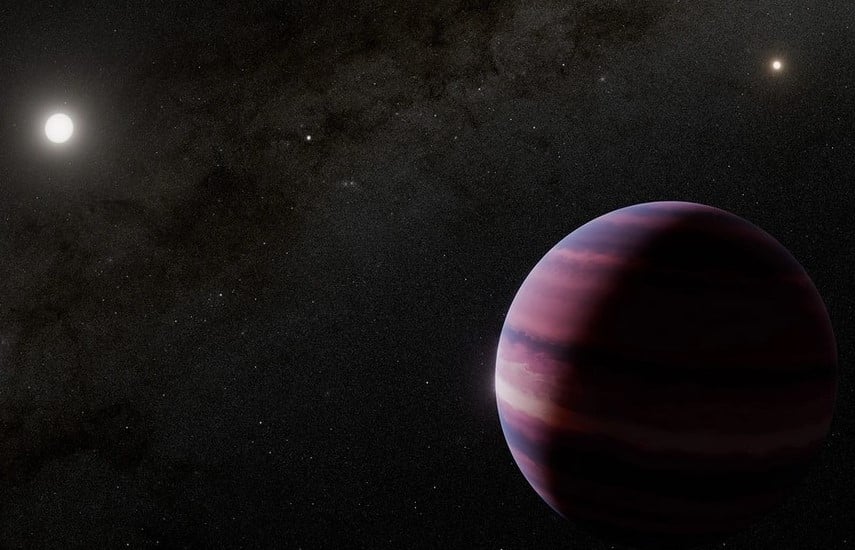
Recent discoveries in the realm of astronomy have stirred excitement among scientists and enthusiasts alike. Imagine a massive planet lurking in the shadows of our closest stellar neighbor! Researchers have recently suggested that a giant planet may be orbiting Proxima Centauri, the star closest to our Sun. This revelation opens up a fascinating avenue of inquiry regarding the potential for life beyond Earth and the characteristics of exoplanets in our galactic backyard.
In this article, we’ll delve into the fascinating details surrounding Proxima Centauri and the implications of a potential giant planet within its orbit. What does this mean for our understanding of the universe? And how does this discovery fit into the broader context of astronomical research? Let’s explore these intriguing questions together.
Understanding Proxima Centauri: Our Nearest Stellar Neighbor
Proxima Centauri is part of a three-star system known as Alpha Centauri. Located approximately 4.24 light-years away, it’s a red dwarf star that has captured the attention of astronomers for years. Due to its proximity, Proxima Centauri is an ideal candidate for studying planetary systems and the possibility of habitable zones.
Furthermore, Proxima Centauri hosts at least one confirmed exoplanet, Proxima b, which orbits within the star’s habitable zone. This zone is crucial because it allows for the potential presence of liquid water, a key ingredient for life as we know it. But what if there is another planet—perhaps much larger—also orbiting this star?
The Discovery of a Potential Giant Planet
Recent observations suggest that a giant planet could be orbiting Proxima Centauri. While details are still emerging, scientists believe this planet may be significantly larger than Earth.
- Such a planet could have profound implications for our understanding of planetary formation.
- Its presence might influence the orbit and conditions of Proxima b.
- Moreover, it could impact the stability of the entire planetary system.
But how do astronomers determine the existence of such distant objects? They typically rely on indirect methods, like observing the gravitational effects a planet has on its star. This can be a complex process, yet advancements in technology have made it increasingly feasible.
Implications for Astrobiology and Future Exploration
The potential existence of a giant planet in the Proxima Centauri system raises intriguing questions about the possibility of life. If such a planet exists, what might its atmosphere and surface conditions be like? Could it harbor life forms different from those on Earth, or might it even support more complex ecosystems alongside Proxima b?
Additionally, this discovery could influence future space missions aimed at exploring nearby star systems. As we continue to develop more advanced telescopes and observational techniques, the hunt for exoplanets becomes increasingly exciting.
The Broader Context: Exoplanet Research and Its Significance
The search for exoplanets is more than just a quest for new worlds; it is a journey toward understanding our own place in the cosmos.
- Every new discovery helps refine our models of planetary systems.
- It also enhances our comprehension of the conditions necessary for life.
- Furthermore, the proximity of these stars provides a unique opportunity for future exploration.
As technology advances, we may soon be able to gather more detailed information about these distant worlds. So, what does this mean for you? It implies that the future of space exploration could be closer than we think, and the potential for discovering life in our cosmic neighborhood is genuinely thrilling.
Stay tuned for more insights as scientists continue to unravel the mysteries of the universe!